
What the Workday AI Lawsuit Means If an Algorithm Rejected You
- August 20, 2026
The Workday AI lawsuit has put a name to something California job seekers have felt for years. You applied for a job that matched your background exactly. The rejection landed within the hour, sometimes within minutes, and no person ever opened your resume. That kind of silence can feel personal, even when you know deep down that you were qualified for the role.
You are not alone in that experience. This case in California asks whether hiring software can break discrimination law, and the answer reaches far past one company. Because California just finished writing its own rules for hiring software, the timing here matters even more.
Quick Answer
What is the Workday AI lawsuit?
The Workday AI lawsuit, formally Mobley v. Workday, is a federal case in California claiming that Workday's AI-powered hiring software rejected job applicants because of their age, race, or disability. A judge has ruled that Workday can be held liable as an agent of the employers that use its software, though no court has decided whether discrimination actually occurred. The deadline to join the related nationwide age discrimination case closed on March 7, 2026, but California employees who believe an algorithm rejected them unlawfully may still bring an individual claim.
Get a Free ConsultationWhat the Workday AI Lawsuit Is About and Who Filed It
Mobley v. Workday, the case most people know as the Workday AI lawsuit, is a federal discrimination claim about hiring software. Derek Mobley filed it in 2023 in the Northern District of California. Workday builds the platform thousands of employers use to collect, sort, and rank resumes. If you have applied for a job through a company’s careers portal, your resume has probably passed through it. Mobley is Black, he is over 40, and he lives with anxiety and depression. He says he applied through Workday portals more than one hundred times without ever moving forward. Frontier Law Center represents California employees exclusively, and we follow Mobley v. Workday closely. The outcome shapes what options you have when a rejection does not feel right.
Why Workday’s Software Defense Fell Short
Workday’s defense in the case is that it only builds the software while employers make the actual hiring decisions. In July 2024, Judge Rita Lin decided that argument does not go far enough. She ruled that a company screening applicants on an employer’s behalf is acting as that employer’s agent. As a result, that agent can be held directly responsible under federal anti-discrimination law. Lin did reject a separate argument that treated Workday as an employment agency. But the agent ruling is the one that matters to you. An employer does not get to hand its hiring decisions to software and walk away from the law. The duty follows the decision, whatever makes it.

Where the Workday AI Lawsuit Stands in 2026
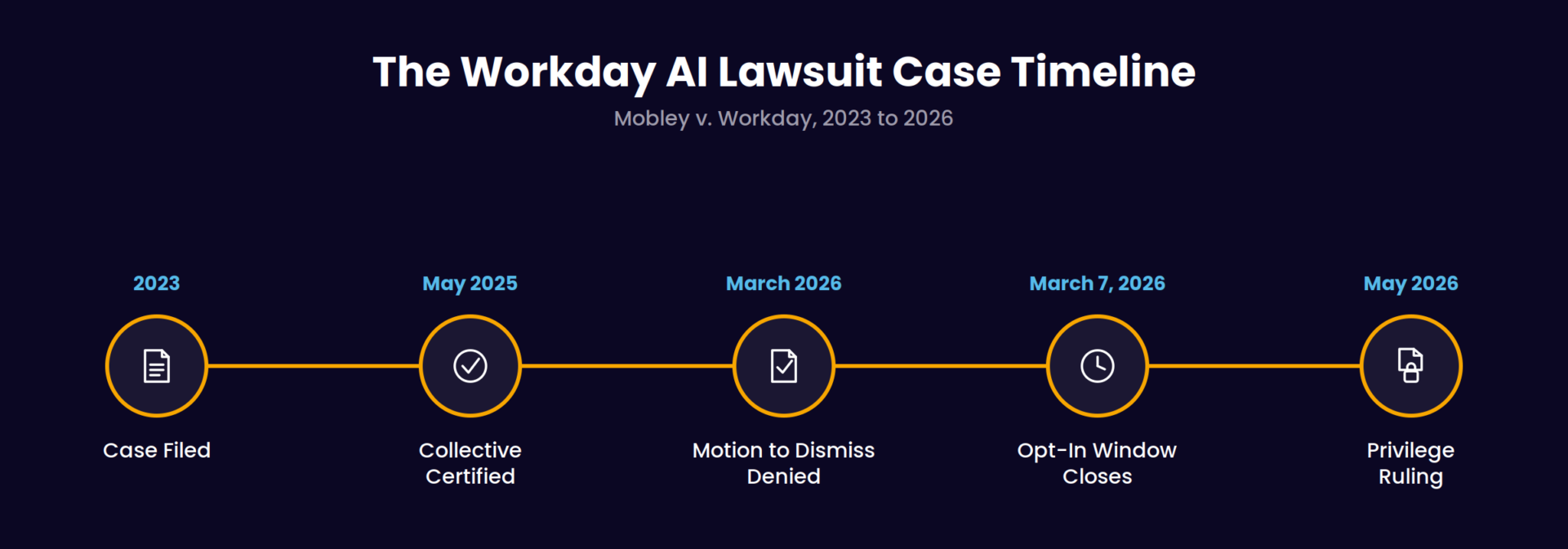
The Workday AI lawsuit has moved through several major rulings since Mobley first filed it in 2023. Each one shapes what a California applicant can still do today. Here is how the timeline has unfolded so far.
The Court Certifies a Nationwide Collective in May 2025
The court preliminarily certified a nationwide collective under the federal Age Discrimination in Employment Act. The group covers applicants aged 40 and older that Workday’s recommendation feature turned down, reaching back to September 24, 2020. Court filings put the number of applications handled in that window at roughly 1.1 billion. Separate class claims under other statutes are still pending.
Workday Loses a Major Argument in March 2026
One day before the opt-in deadline, the court rejected a key Workday argument. Workday claimed the federal age discrimination law protects only current employees, not job applicants like Mobley. That ruling let the age discrimination claims move forward. Still, a court allowing a case to continue is not the same as a court finding that discrimination happened.
The Opt-In Window Closes on March 7, 2026
About fourteen thousand people opted in before the deadline passed, and joining that specific collective is no longer possible. Your own claim, if you believe you have one, stands entirely apart from that closed group.
A Discovery Ruling Favors Workday in May 2026
The court held that some of Workday’s bias-testing material can fall under attorney-client privilege. However, no court so far has found Workday liable for discriminating against anyone. Every ruling to date deals with court process rather than the merits of the underlying claim.
How California Law Treats Automated Hiring Decisions
California did not wait for the Workday AI lawsuit to reach a verdict before acting. On October 1, 2025, new rules from the California Civil Rights Council took effect, applying FEHA directly to AI-powered recruiting software. Under these rules, an automated-decision system means any computer process that makes or shapes a job decision during the hiring process. Employers cannot use algorithm-based screening tools in a way that discriminates against applicants on a protected basis.

What the New Rules Mean for Your Rejected Application
The rules cover neutral-looking tools that still produce biased results. They also cover data points that stand in for protected traits, like graduation year or zip code. Employers must now keep automated-decision data for four years. That covers what goes in and what comes out, so the record behind your rejection should still exist.

Why the Software Vendor Can End Up on the Hook Too
California treats a company that does hiring work for an employer as that employer’s agent. Screening software sits inside that definition whenever it picks who moves forward. What that means for you is simple. An employer cannot escape a claim by pointing at the vendor, and the vendor cannot hide behind the employer either.

How Long California Employees Have to Act After a Biased Hiring Decision
California deadlines run longer than federal ones, yet they still expire. Your own deadline does not pause while the Workday AI lawsuit continues. Acting early matters even more here, since evidence fades fast. For example, court cases like this one can take years to resolve. Proving what happened often depends on records that only the employer and the software provider hold.
The table below breaks down your filing window based on the type of claim that fits your situation.
| Claim Type | What It Covers | Filing Deadline |
|---|---|---|
| FEHA discrimination claim | Age, race, or disability bias built into an employer's screening process | 3 years to file with the CRD, then 1 year to sue after a right-to-sue letter |
| Federal ADEA or Title VII claim | The same bias claims under federal anti-discrimination law | 300 days to file a charge with the EEOC |
| Claims against multiple employers | Each employer that used the same flawed screening tool | Every rejection can carry its own separate deadline |
Most of these claims rest on a theory called disparate impact. Under it, you do not have to prove that anyone meant to discriminate. Our guide to employment claim deadlines in California walks through each of these timelines in more depth, including the tolling exceptions that can extend them.
Signs an Algorithm May Have Screened You Out Illegally
Screening software rarely announces itself to the person on the other end. Still, patterns emerge once you step back and review several job applications side by side. A rejection landing minutes after you hit submit usually means algorithm-based screening tools made the call. Speed by itself does not prove bias, but repeated instant rejections for roles that fit your background are worth writing down.
Personality quizzes, timed games, and video interviews that grade facial expressions or vocal tone can filter out people with disabilities. They can also hurt older applicants and other protected communities whose answers differ from what the system learned to reward. In fact, California regulators have flagged these tools as an area of concern. One rejection tells you almost nothing on its own. Still, twenty rejections through the same platform, for jobs well inside your experience, start to look like something else entirely.
You do not need to prove anyone’s intent to have a claim.
You just need to show a clear pattern. Many of Frontier Law Center’s most successful clients started out unsure a computer was even involved.
Signs Worth Writing Down
- A rejection arrived within minutes of you submitting the application
- You completed a personality quiz, timed game, or video interview during the process
- The same platform rejected you across many applications for roles you were qualified for
- Your rejection came faster than a person could have realistically read your resume
- Different employers that appear to use the same system produced the exact same result for you
- At 40 or older, you noticed this pattern more than once
- You live with a disability that a video or game-based assessment could have penalized
Your Rights After an Illegal Algorithmic Rejection
California and federal law both give you specific protections here, the same ones raised in the Workday AI lawsuit. A screening algorithm may be the exact reason you never made it past the first round. The bias can involve age, disability, race, or color. The table below breaks down common situations, the right that applies, and the law behind it.
| Situation | Your Right | Relevant Law |
|---|---|---|
| Screening software filters you out based on age | Protection from age discrimination in hiring | California FEHA; federal ADEA |
| A timed assessment screens out your disability | Right to request a reasonable accommodation during the application process | California FEHA; federal ADA |
| A neutral tool rejects one protected group far more often | Right to challenge the disparate impact | Cal. Code Regs., tit. 2, § 11008.1 |
| An outside vendor runs the screening for your employer | Right to pursue the agent, not only the employer | California FEHA agent liability rules |
| You object that the tool discriminates and the employer drops you | Protection from retaliation for opposing discrimination | California FEHA, Gov. Code § 12940(h) |
Questions California Employees Ask About Being Screened Out by an Algorithm
These questions come up again and again from people who suspect an algorithm made the call. The allegations behind the Workday AI lawsuit, a landmark case for California employees, made many people ask the same things. Employee rights groups like Workplace Fairness hear versions of them every day. Here are straight answers to the five that surface most often.
Can a Company Legally Use AI to Decide Who Gets an Interview?
Yes, California lets employers use AI screening tools when they hire. The law limits how employers may use those tools rather than banning them outright. Once a system produces biased results on a protected basis, you may have a claim against that employer. The same standard applies whether a person or a program made the hiring decision.
How Do I Find Out If an Algorithm Rejected My Job Application?
Timing is the clearest signal that AI-powered hiring tools rejected your application. A job routed through a company portal is another good clue. You can also ask the employer or HR in writing whether it used software, since California employers must now keep that data for four years.
Is It Still Possible to Join the Workday AI Lawsuit?
No, the opt-in deadline for the nationwide age discrimination collective in the Workday AI lawsuit passed on March 7, 2026. That closure does not affect your own claim, though. If a California employer’s screening tool filtered you out unlawfully, you may still have a case. State and federal law both give you a path forward.
Can I Sue a California Employer If Software Made the Hiring Decision?
Yes, an employer stays responsible for what its screening tools produce. California rules treat companies running hiring work for an employer as agents, so that framing can bring the software provider into a case alongside the employer. Handing a decision to an algorithm does not move the legal risk away from the business that benefits from it.
Does California Make Employers Test Hiring Software for Bias Before Rejecting You?
No, California stops short of requiring bias audits of hiring tools. The rules instead make testing count as evidence, and a court weighs its quality, age, and scope. When an employer never tested a tool for artificial intelligence bias at all, that silence can support your claim rather than protect the company.
Find Out Whether an Algorithm Cost You a Job You Earned
Getting screened out by a system you cannot see is a strange kind of loss, since there is no conversation to replay and no manager to question. You still deserve a straight answer about whether what happened to you was legal, and that answer starts with whatever records you kept.
Bring what you saved, even if it feels thin. Frontier Law Center will tell you honestly whether it adds up to a claim. We handle workplace discrimination claims for California employees, including age discrimination cases for applicants over 40. Contact Frontier Law Center to schedule a free case evaluation and find out what your options are.
More Blogs

What the California 10-Minute Break Law Requires and What Missed Breaks Pay
What the California 10-Minute Break Law Requires and What Missed Breaks Pay

Is Working Off the Clock in California Legal Even If You Volunteer?
Is Working Off the Clock in California Legal Even If You Volunteer?

Signing a Severance Agreement Over 40 Gives You Rights Younger Employees Do Not Have
Signing a Severance Agreement Over 40 Gives You Rights Younger Employees Do Not Have

Can You Still Sue After Signing a Severance Agreement in California?
Can You Still Sue After Signing a Severance Agreement in California?

What to Do If You’re Sexually Harassed at Work in California
What to Do If You’re Sexually Harassed at Work in California

How to Tell If Discrimination in Hiring Cost You a Job in California
How to Tell If Discrimination in Hiring Cost You a Job in California