
AI Layoffs in California and What to Do If an Algorithm Put You on the List
- September 14, 2026
AI layoffs are a new and still-developing use of workplace AI. For years, that technology mostly stayed in the background, drafting emails, summarizing meetings, and sorting resumes. Even so, that work sits far from the decisions that end a career.
That distance between the two is closing. Some of the same systems now feed data into performance rankings. In a few recent cases, those rankings appear to decide who stays when a company cuts jobs. California is already testing this in court. Then, in July 2026, a group of Meta employees sued over exactly this kind of selection process.
That case matters because AI layoffs raise a question employment law has never faced. A manager’s layoff decision can be explained and challenged. Still, a score built from login hours and keystroke counts cannot, at least not without the underlying data. So the employee learns only that a restructuring took place. They never learn why their name appeared on the list while the colleague beside them kept their job.
Quick Answer
Can You Sue If AI Selected You for a Layoff in California?
Yes, you can sue if the criteria behind an AI-assisted layoff discriminated against you based on age, disability, pregnancy, or protected leave. The layoff label itself does not decide the question. What matters is whether the scoring behind it penalized approved leave or treated a protected condition as a performance problem. California's automated-decision-system rules, in effect since October 2025, extend that protection directly to layoffs built with software.
Get a Free ConsultationWhat AI Layoffs Actually Look Like Inside a California Company
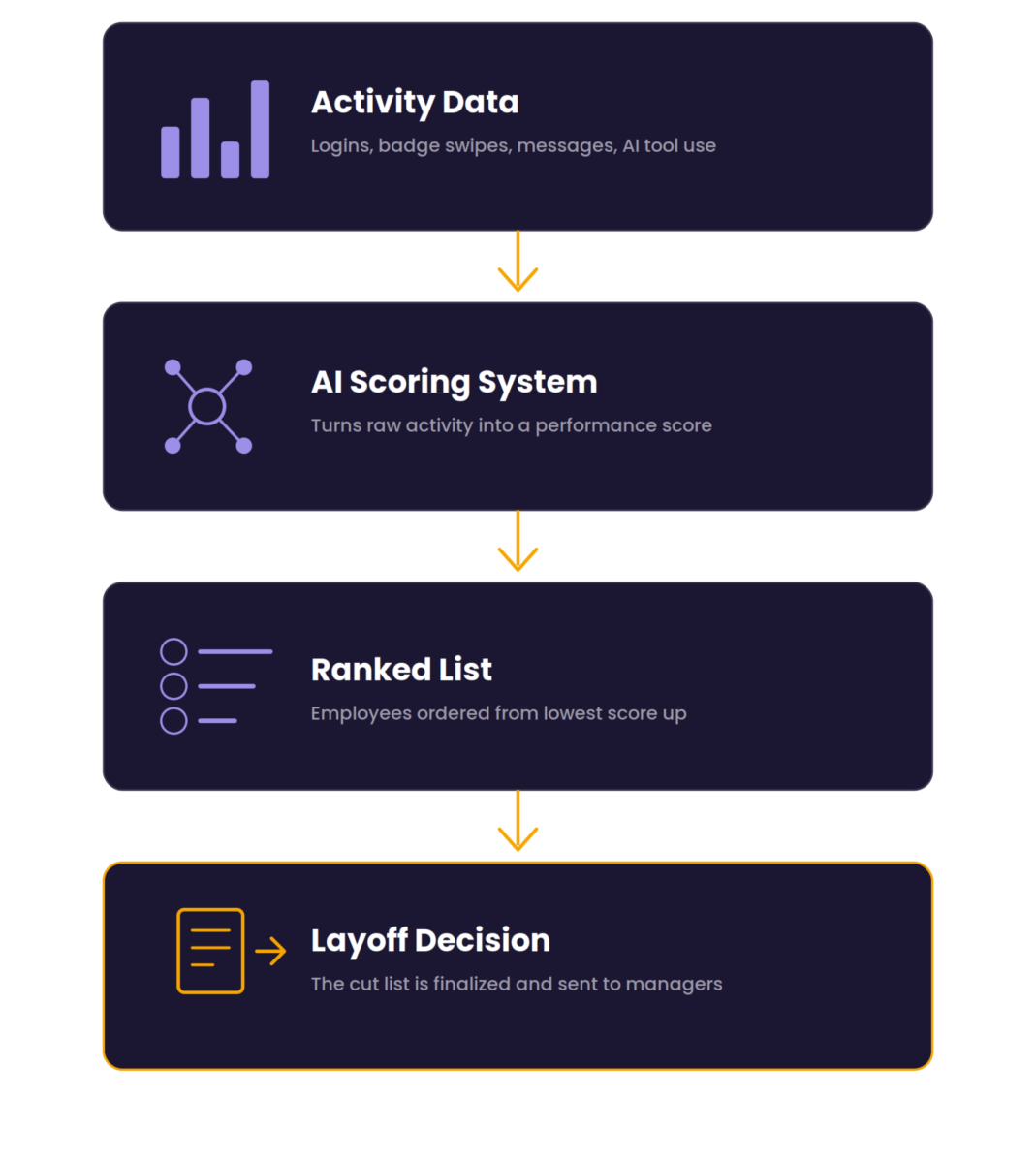
AI layoffs rarely come from one program that reads files and picks names. Instead, several systems each add a piece of the picture, and only then does an employer build the actual cut list. Frontier Law Center represents California employees exclusively, and we hear a version of this story often.
The trend reaches far beyond one company. TechCrunch reported that tech employees absorbed roughly 120,000 job cuts in 2026 alone. AI was cited as the leading reason, according to outplacement firm Challenger, Gray and Christmas. At least 11 companies have each announced AI-related cuts affecting 10,000 or more employees since 2025. The pattern now reaches sales, customer service, support staff, and editorial roles across the supply chain, not just engineering. Many employees describe the same experience across a global workforce. AI companies and traditional employers alike cite AI strategy and AI efficiency while reshaping workforce roles.
How AI Layoff Scores Could be Built
Your employer might track far more than your finished work. Badge swipes, login hours, message volume, and keystroke activity all get recorded as a matter of course. Some dashboards even measure how often you use company AI tools.
That data looks neutral, since it never asks about your age or your health. Still, some employees cannot post the same numbers. Someone recovering from surgery generates almost no logins for weeks. A new parent on bonding leave sends no messages at all. Once a system measures presence and speed above all else, both sink to the bottom.

What the Meta Case Says About Letting Software Pick the List
Meta faces the clearest test case of AI layoffs so far. Twenty six employees sued the company in federal court in Oakland in July 2026, after it announced roughly 8,000 job cuts. Their complaint points to keystroke monitoring, activity data, and AI usage dashboards that replaced manager judgment.
Most of the employees who sued were out on leave, covering pregnancy, parental, and medical leave, plus disability accommodations. Their theory: neutral metrics stood in for protected status, a theory the law calls disparate impact. Coverage has leaned just as heavily on the federal FMLA angle.
What the Court Has Decided and What Remains Open
Very little has been settled so far, so treat the case as a live dispute. The judge refused to pause the layoffs on July 17, 2026, since the employees had not shown the harm an emergency order requires. That same order still flagged serious questions on the merits.
Then, by late August, at a hearing on a longer injunction, the judge sounded more skeptical of the employees’ odds and pointed toward arbitration as the real venue for these claims. Still, Meta denies using AI to make the decisions, and no court has ruled that the company broke any law.
How California Law Protects Employees From Unfair AI Layoffs
California moved on AI layoffs before any court did, putting employees on firmer ground. New rules from the California Civil Rights Council took effect on October 1, 2025, extending the Fair Employment and Housing Act to automated decision systems. Any computer process that shapes a job decision counts, including one that picks who gets laid off. Employers must also keep that data for four years, and bias testing becomes evidence too.
California and federal leave laws already protect the time a score treats as a gap. The California Family Rights Act protects approved absence, as do Pregnancy Disability Leave and the federal Family and Medical Leave Act. Even so, broader leave and benefit protections apply no matter what a dashboard recorded. In fact, counting protected leave against you is not a neutral act, since a score that treats lawful absence as poor work can support a claim.
| Situation | Your Right | Relevant Law |
|---|---|---|
| A layoff score counts weeks you spent on approved medical leave | Protection from being penalized for using protected leave | California CFRA; federal FMLA |
| Activity metrics drop because of an approved accommodation | Right to an accommodation without losing your job over it | California FEHA; federal ADA |
| A neutral ranking cuts employees over 40 at a far higher rate | Right to challenge the disparate impact of the criteria | California FEHA; federal ADEA |
| Software makes or shapes the layoff decision | Right to the underlying data, which the employer must keep for four years | Cal. Code Regs., tit. 2, § 11013 |
| You raise concerns about the selection method and get cut | Protection from retaliation for opposing discrimination | California FEHA, Gov. Code § 12940(h) |
Can You Be Fired While on Medical Leave Because a Score Dropped
Yes, AI layoffs can reach you while on medical leave, since protected leave does not make your position permanent. What matters is whether the scoring penalized your absence, since a measuring period that overlaps your leave reflects the leave, not your work. Because the employer chose that window on its own, ask whether the company adjusted for protected time at all.
Getting Laid Off on Maternity Leave When AI Builds the List
Parental leave creates the same problem, only faster, since a bonding leave of several months can wipe out a whole scoring period. Meanwhile, the new parent competes against people who never stopped logging activity.
California also treats pregnancy and related leave as protected. Still, a ranking that turns that leave into a low score deserves a hard look. Our guide to what a wrongful termination claim requires shows how these pieces fit.
Signs You Were Targeted by Unfair AI Layoffs
No employer announces that AI layoffs targeted you, so patterns matter more than any explanation given after the fact. Several signs come up again and again.
The timing of a score drop matters as much as the stated reason. A ranking that fell right after protected leave or a complaint carries weight, and so does a cut list that skews toward one protected group.
You don’t need to prove the algorithm was biased.
Just tell us what happened, and we’ll help you find out if it was legal. Many clients started by saying they were not sure they had a case.
Common Signs Your AI Layoff May Have Been Illegal
- Your score dropped sharply right after protected leave or an accommodation request
- You were the only one on your team cut while on leave or after returning
- The group let go skewed toward older or pregnant employees, or people with disabilities
- You raised a concern about the selection method and were cut soon after
- Your manager could not explain why the algorithm picked you
Why AI Layoffs Are Not Automatically Illegal in California
AI layoffs are not automatically illegal in California. Employers may also cut positions, restructure teams, and adopt tools that take over work employees used to do. Money reasons for a layoff are lawful even when the result feels unfair. Whether AI is truly driving this wave remains in dispute, and RAND researchers report that employers adopting AI more often see job gains than losses.
The method turns into a legal problem when the result discriminates, such as criteria that sweep out older or disabled employees at a much higher rate. AI cannot serve as a silver bullet excuse for a decision that actually targeted a protected characteristic. Intent is not the test under a disparate impact theory. Instead, courts tend to ask two questions. Did a neutral rule fall harder on a protected group? Was the rule truly needed for the job?

What California Employees Can Do After an Algorithmic Layoff
Several steps protect your options after AI layoffs, well before you commit to filing anything.

Save Your Records and Ask for the Selection Criteria
Company accounts usually shut off within a few hours, so screenshot any dashboard or ranking you can still reach, then forward what you can. Also ask what criteria decided the layoff list in a short, neutral email. Even a refusal helps you, since it dates your question.

Read the Severance Paperwork Before the Clock Runs Out
Severance agreements almost always waive your right to sue, and group layoffs with employees over 40 come with extra rules. Federal law generally gives you 45 days to consider the waiver, plus seven more days to revoke it. Our post on what to check before signing a severance agreement covers the traps.

Questions California Employees Ask About AI Layoffs
These questions come up once employees start doubting the method behind AI layoffs more than the business reason for the cut.
Can You Sue Over AI Layoffs in California and How Long Do You Have?
Yes, suing over AI layoffs in California turns on why your name appeared on the list, instead of the label itself, and whether the criteria hurt a protected group.
Deadlines run longer in California than under federal law, though they still expire. You generally have three years to file with the California Civil Rights Department, then one year to sue after a right-to-sue notice. Meanwhile, a federal charge with the EEOC comes due within 300 days. Our full guide to California employment filing deadlines breaks down each clock.
Large layoffs also trigger the California WARN Act, which requires 60 days of written notice, no matter what software recommended.
Does California Require My Employer to Tell Me Software Ranked Me?
No, California has no statute forcing that disclosure right now. The No Robo Bosses Act was vetoed in 2025. Even so, Civil Rights Council rules make employers keep the data for four years.
Can My Keystroke and Activity Data Be Used to Justify Cutting My Job?
Yes, employers may rely on activity data they lawfully collected. That data becomes a problem only when it stands in for age, disability, pregnancy, or leave.
What Happens to My Productivity Score If I Was Out on Leave?
Protected leave should not lower your standing at work, since California and federal law both bar penalties for approved absence. Whenever a scoring window covers your leave without adjustment, that gap can become evidence.
Does Signing a Severance Agreement Waive My Right to Challenge an AI Layoff?
Yes, the California Employment Development Department pays partial benefits when your hours drop through no fault of your own. You can apply while still working your reduced schedule. The EDD calculates your weekly benefit based on the gap between your current and prior earnings. Many employees in this situation do not realize they qualify until they ask.
Find Out Whether Your Layoff Was Actually Legal
AI layoffs can feel like getting cut by a process you never saw, since there is no conversation to replay and no decision maker left to question, just a short notice and a badge that stopped working. You still deserve a straight answer about what happened, whether a score pushed you off the list, or you were on leave, recovering, or older than the people who stayed.
Bring what you saved, however thin it feels. As an AI-native firm, Frontier Law Center understands how these systems work and where they cross a legal line. We handle wrongful termination claims for California employees. That includes disability discrimination, age discrimination, and hiring-side automated screening cases where a neutral rule did the damage. Contact Frontier Law Center to schedule a free case evaluation.
More Blogs
Quid Pro Quo Harassment Explained, and How It Differs From a Hostile Work Environment
Quid Pro Quo Harassment Explained, and How It Differs From a Hostile Work Environment

What Is Constructive Discharge in California? When Being Forced to Quit Counts as Firing
What Is Constructive Discharge in California? When Being Forced to Quit Counts as Firing

What Is a PAGA Claim? How California Employees Sue on Behalf of the State
What Is a PAGA Claim? How California Employees Sue on Behalf of the State

Can Your Employer Take Away a Reasonable Accommodation in California?
Can Your Employer Take Away a Reasonable Accommodation in California?

How to Report Sexual Harassment at Work in California
How to Report Sexual Harassment at Work in California

Workplace Discrimination Examples California Employees Should Know How to Spot
Workplace Discrimination Examples California Employees Should Know How to Spot