
How to Tell If Discrimination in Hiring Cost You a Job in California
- September 17, 2026
Getting turned down for a job you were qualified for is disorienting enough, and it gets worse when nobody tells you why. You replay the interview afterward, wondering if it was the salary question you asked or something you said. That silence is exactly what makes discrimination in hiring so hard to recognize. Most people assume a mystery rejection means they have nothing to work with.
That assumption is wrong more often than California job seekers realize. Employers keep more records about your application than you might expect, and recent state rules require many of them to hold that data for years. A rejection that felt like a dead end may still leave behind a paper trail worth examining.
Quick Answer
Can I File a Discrimination Claim Against a Company That Never Hired Me?
Yes. California's Fair Employment and Housing Act protects job applicants during the hiring process itself, so you need no job offer, no start date, and no time on the payroll to have a claim. If a protected trait factored into your rejection, that rejection can violate the same statute that protects current employees.
Get a Free ConsultationWhat Counts as Discrimination in Hiring Under California Law
An employer breaks California law the moment a protected trait factors into a hiring decision. That can show up in a job posting, an interview question, or a final rejection letter. Frontier Law Center represents California employees exclusively in workplace discrimination and harassment claims, and we see how often hiring-stage bias goes unrecognized. There is no coworker to compare notes with and no personnel file to review, only a rejection and a guess. Our guide to how FEHA protects California employees covers the statute in more depth.

The Protected Characteristics California Covers
California protects a longer list of characteristics than federal law does, and that difference matters when you weigh your own situation. Race, color, national origin, ancestry, and religion all appear in the statute. So do sex, gender identity, sexual orientation, and age over 40. Disability, medical condition, marital status, and military status round out the list.
Because the list runs long, many people never connect their rejection to it. Someone turned down after mentioning a pregnancy often blames bad timing instead. Someone over 50 assumes the market simply moved on without them. A pattern of rejections tied to your name alone may even signal racial discrimination rather than a fit problem.

Where Employer Preference Ends and Hiring Bias Begins
Employers may hire whoever they think is strongest, and preferring one background over another is usually lawful on its own. That line moves, however, once a protected trait starts to drive the outcome. Proof of bad intent is not the test that decides it.
A neutral-looking rule can still break the law. It does so when it screens out one protected group far more often than others, regardless of what the employer meant by it. Courts call that theory disparate impact, and it needs no proof of bad motive to hold up.
National audit testing repeatedly backs this up. These studies send identical resumes and change only the applicant’s name. Resumes read as belonging to white men still draw more callbacks than the same resumes under different names. That gap holds whether the name reads as Black men, Black women, or white women. Equal Employment Opportunity Commission (EEOC) data shows the same gap by race and color, and Black employees and women employees report it most often.

How Unfair Hiring Practices Show Up During the Application Process
Bias at the hiring stage looks nothing like bias inside a workplace. You never see the room where the decision actually happens. Instead, the signals show up in the process itself, in the wording of a posting, the questions asked during an interview, or how quickly a rejection arrives. These patterns usually become visible only once you compare several applications side by side.
A single odd question or one fast rejection rarely proves anything by itself. However, what separates a routine rejection from a real legal claim is whether what happened connects back to a protected characteristic rather than simple fit.
You do not need to prove intent to have a claim.
A pattern of small signals, tracked honestly and compared side by side, is often enough for an attorney to see what feels invisible from the inside.
Signs of discrimination in hiring worth tracking include:
- A job posting requires a recent graduation date or an unbroken work history
- An employer asks about your conviction record before making a conditional job offer
- An interview question touches on your age, religion, disability, or family plans
- You are asked what you previously earned instead of being told the pay scale
- A rejection arrives within an hour, faster than anyone could realistically read your resume
- The same employer rejects you across several roles well inside your experience
When Automated Screening Tools Cross Into Illegal Bias
Most large California employers now route applications through AI-driven software that scores and ranks people before anyone reads a resume. That shift changed how discrimination in hiring can happen without changing who answers for it. Our coverage of the Workday AI lawsuit walks through a real case built on exactly this problem.
What California’s Automated Decision Rules Changed in 2025
New rules from the California Civil Rights Council took effect on October 1, 2025, applying existing discrimination law directly to hiring software. An automated-decision system now means any computer process that makes or shapes a job decision. Employers must keep that data for four years, and whether a company tested its tool for bias becomes evidence. California still stops short of requiring those tests.
Why Discrimination in Hiring Can Come From a Neutral Algorithm
Screening software produces biased outcomes even when nobody designs it to discriminate. It learns from past hiring choices and repeats what already existed. A tool trained mostly on a young workforce, for example, keeps favoring younger applicants. Fields like graduation year or zip code can quietly stand in for a protected trait without naming one. In short, a rejection is no more lawful for coming from a machine than from a person.
| Situation | Your Right | Relevant Law |
|---|---|---|
| An interviewer asks about your age, pregnancy, or family plans | Right to be judged without regard to that trait | California FEHA, Gov. Code section 12940 |
| A posting requires a recent graduation date | Right to challenge a rule that screens out applicants over 40 | California FEHA, federal ADEA |
| A cognitive ability assessment or other employment test screens out your disability | Right to ask for an accommodation while you apply | California FEHA, federal ADA |
| Screening software rejects one protected group far more often | Right to challenge the disparate impact of a neutral tool | Cal. Code Regs., tit. 2, section 11008.1 |
| You raise a concern about bias and the employer drops you | Protection from retaliation for opposing discrimination | California FEHA, Gov. Code section 12940(h) |
What Evidence Helps Prove Discrimination in Hiring
Applicants usually assume they need a confession, and that assumption kills good claims before they start. In fact, these cases rest on records, timing, and comparisons. Our broader guide to how to prove discrimination at work in California covers that same framework for current employees. The evidence below is specific to what an applicant can still reach.

Records You Should Save Before They Disappear
Save the job posting, your confirmation email, and the rejection notice. Postings come down fast, so screenshot the listing instead of bookmarking it. Note the date and time of every submission, since timing shows whether anyone read your materials. Forward the whole set to a personal email account you control.
Comparing Yourself Against Whoever Got the Role
Check whether the employer reposted the same job after rejecting you. If so, a listing that reappears unchanged suggests your experience was not the problem. Public profiles often reveal who filled the role, and if that person looks like a weaker fit, the comparison becomes evidence rather than a hunch.
What the Employer Must Keep on File
California requires employers to keep application records for four years, including automated-decision data. The paperwork behind your rejection often still exists. You can send a short written request about software screening, and even a non-answer creates a dated record showing you asked early.
How Long California Applicants Have to Act After a Job Rejection
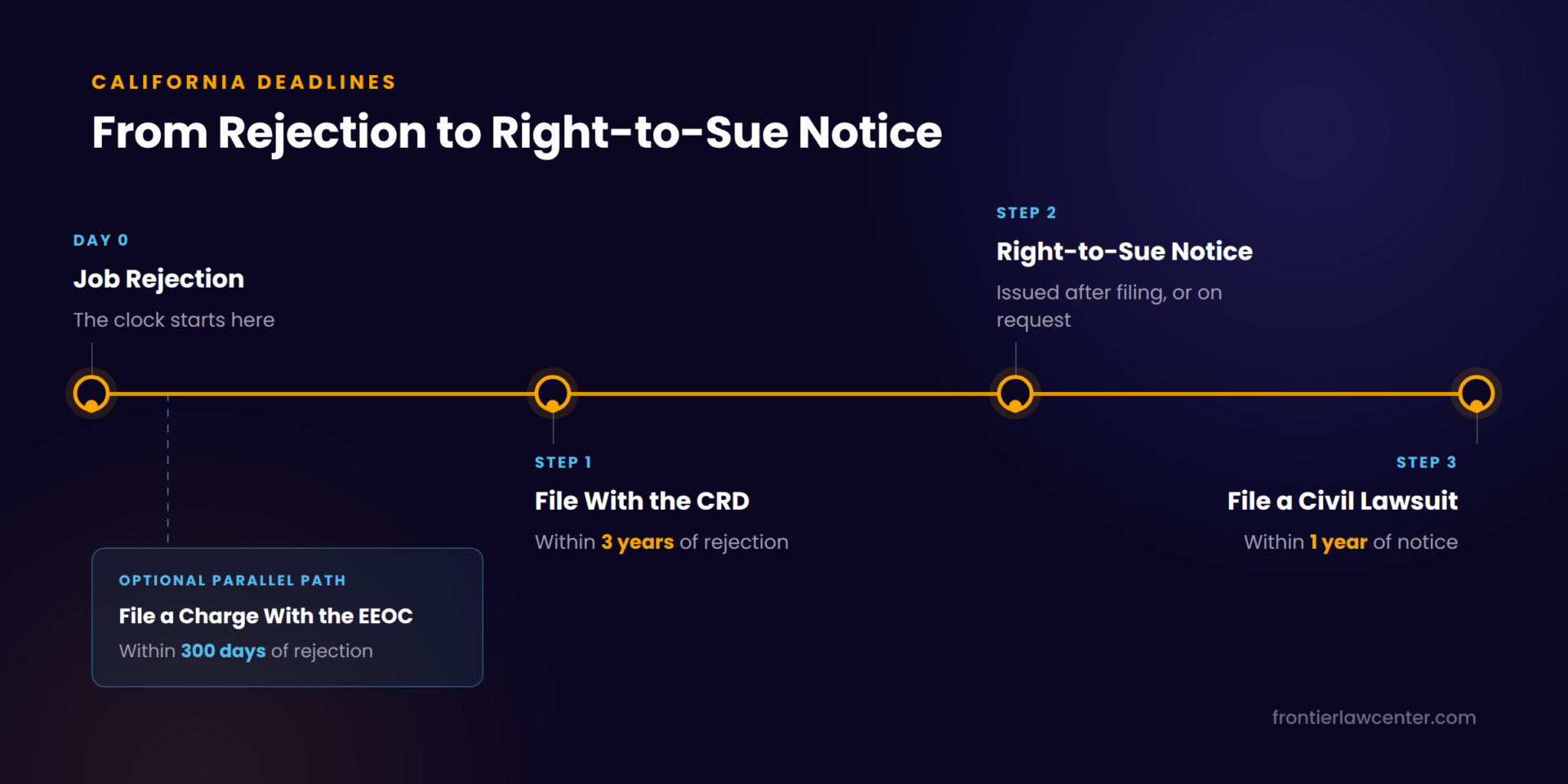
Every deadline here runs from the day your rejection arrives, not the day you decide to act. Still, California gives you more room than federal law does, though that room does close.
| Step | What It Involves | Deadline |
|---|---|---|
| File with the California Civil Rights Department | An administrative complaint alleging your rejection violated FEHA | 3 years from the date of your rejection |
| Receive a right-to-sue notice | The CRD authorizes you to take your case to civil court | Issued once your complaint is filed, or right away if you request it |
| File a civil lawsuit | Your hiring discrimination claim proceeds in California Superior Court | 1 year from your right-to-sue notice |
| File a parallel charge with the EEOC | An optional federal complaint under Title VII or the ADEA | 300 days from the date of your rejection |
Our breakdown of employment claim deadlines in California shows how these timelines interact. Acting early also beats waiting for more clarity, since records grow harder to reach as memories fade and systems purge old data.
How to Respond to Discrimination in Hiring in California
Start by writing out every role, company, and platform involved, along with the name of everyone you spoke with and the date of each conversation. Note anything unusual that was said during a call or an interview. That timeline turns a vague sense of unfairness into something an attorney can actually evaluate, and memory fades faster than most applicants expect.
From there, you can file directly with the California Civil Rights Department at no cost. The agency will investigate your complaint or issue a right-to-sue notice depending on your situation. Many applicants still speak with a lawyer before filing, since how a complaint gets framed can shape what follows. Groups like Workplace Fairness publish plain-language guides if you want to learn more before you reach out.
Questions California Job Applicants Ask About Hiring Discrimination
These questions come up constantly from people who suspect discrimination in hiring cost them a job. Here are direct answers to the five we hear most.
Can I File a Discrimination Claim Against a Company That Never Hired Me?
Yes, because California protects job applicants during the hiring process itself, and FEHA covers the decision to hire, not just what happens afterward. You need no offer letter and no time on payroll to have a claim.
Your remedies may still differ from those of a current employee, since the claim rises or falls on why you were rejected.
What Job Interview Questions Are Illegal for California Employers to Ask?
California employers cannot ask about your age, religion, disability, or national origin. Questions about marital status, pregnancy, and family plans are also off limits.
An improper question alone does not prove a violation, but it creates useful evidence once the employer rejects you.
How Do I Prove I Was Passed Over for a Job Because of Discrimination?
You prove these claims through patterns rather than admissions. Timing, reposted listings, and shifting employer explanations all carry weight. Statistics across an employer’s applicant pool can help too, and that material often sits in records the employer must keep.
Does Being Told I Am Overqualified Count as Hiring Discrimination?
Sometimes, because overqualified can function as shorthand for age concerns, and California courts have treated the word as possible evidence of age bias. Even so, it does not settle anything alone, since companies sometimes mean exactly what they say.
What Happens After I Report Hiring Discrimination to the Civil Rights Department?
The agency reviews your complaint and may investigate, offer mediation, or issue a right-to-sue notice depending on caseload. Alternatively, you can request an immediate right-to-sue notice, and many applicants choose that route when they already plan to sue.
Find Out Whether a Job Rejection Crossed a Legal Line
A rejection with no explanation feels impossible to challenge. There is no manager to question and no conversation to replay. That is exactly why so many applicants let it go. Still, you deserve a straight answer, and a handful of saved emails and job postings is often enough to get one.
Frontier Law Center handles workplace discrimination claims for California employees every day. That includes age discrimination and disability discrimination cases where people got filtered out before anyone met them. Contact Frontier Law Center to schedule a free case evaluation and find out whether your pattern adds up.
More Blogs

What to Do If You’re Sexually Harassed at Work in California
What to Do If You’re Sexually Harassed at Work in California

PAGA Reform Explained, What Changed for California Employees
PAGA Reform Explained, What Changed for California Employees

Quid Pro Quo Harassment Examples Every California Employee Should Recognize
Quid Pro Quo Harassment Examples Every California Employee Should Recognize

Race Discrimination in the Workplace and Your Rights as a California Employee
Race Discrimination in the Workplace and Your Rights as a California Employee

AI Layoffs in California and What to Do If an Algorithm Put You on the List
AI Layoffs in California and What to Do If an Algorithm Put You on the List

Quid Pro Quo Harassment Explained, and How It Differs From a Hostile Work Environment
Quid Pro Quo Harassment Explained, and How It Differs From a Hostile Work Environment