
Can You Still Sue After Signing a Severance Agreement in California?
- September 18, 2026
The paperwork went back signed weeks ago, the severance money landed, and you told yourself the chapter was closed. Then something surfaced that changed the picture, and now you are asking whether you can sue after signing a severance agreement in California. Maybe a comment from your manager started replaying at odd hours. Or a former coworker finally told you what happened in the meetings you missed.
That feeling deserves a straight answer rather than a hedge. So the honest version of the answer runs like this. Your signature narrowed your options without closing all of them.
Frontier Law Center represents California employees only, and people asking whether they can sue after signing a severance agreement reach us constantly.
Quick Answer
Can you sue after signing a severance agreement in California?
You can sometimes sue after signing a severance agreement in California, because a release cannot legally reach every claim. Wages you already earned, charges filed with a government agency, and anything your employer did after you signed all fall outside a standard release. Whether claims you never knew about survive comes down to one paragraph, the Civil Code 1542 waiver.
Get a Free ConsultationWhat You Gave Up When You Signed That Severance Agreement
Usually a severance deal pays you money in exchange for one promise, which is that you will not sue. Lawyers call that promise a release of claims, and it usually sits in one dense paragraph near the middle of the document. So whether you can sue after signing a severance agreement starts with what that one paragraph reached and what it never touched.

The Release of Claims Paragraph Buried in the Middle of the Document
To begin with, your release lists the claims you agreed to drop. Usually the language sweeps broadly, gathering discrimination, retaliation, wrongful firing, and wage claims under a single heading. Even so, a waiver only counts when you gave up the right knowingly and voluntarily. Courts look at whether the language stayed clear and whether you had real time to read it. They also check whether anyone told you to consult a lawyer. Still, a vague or buried release holds up less often than employers tend to assume.

Whether the Wording Reaches Claims You Did Not Know About
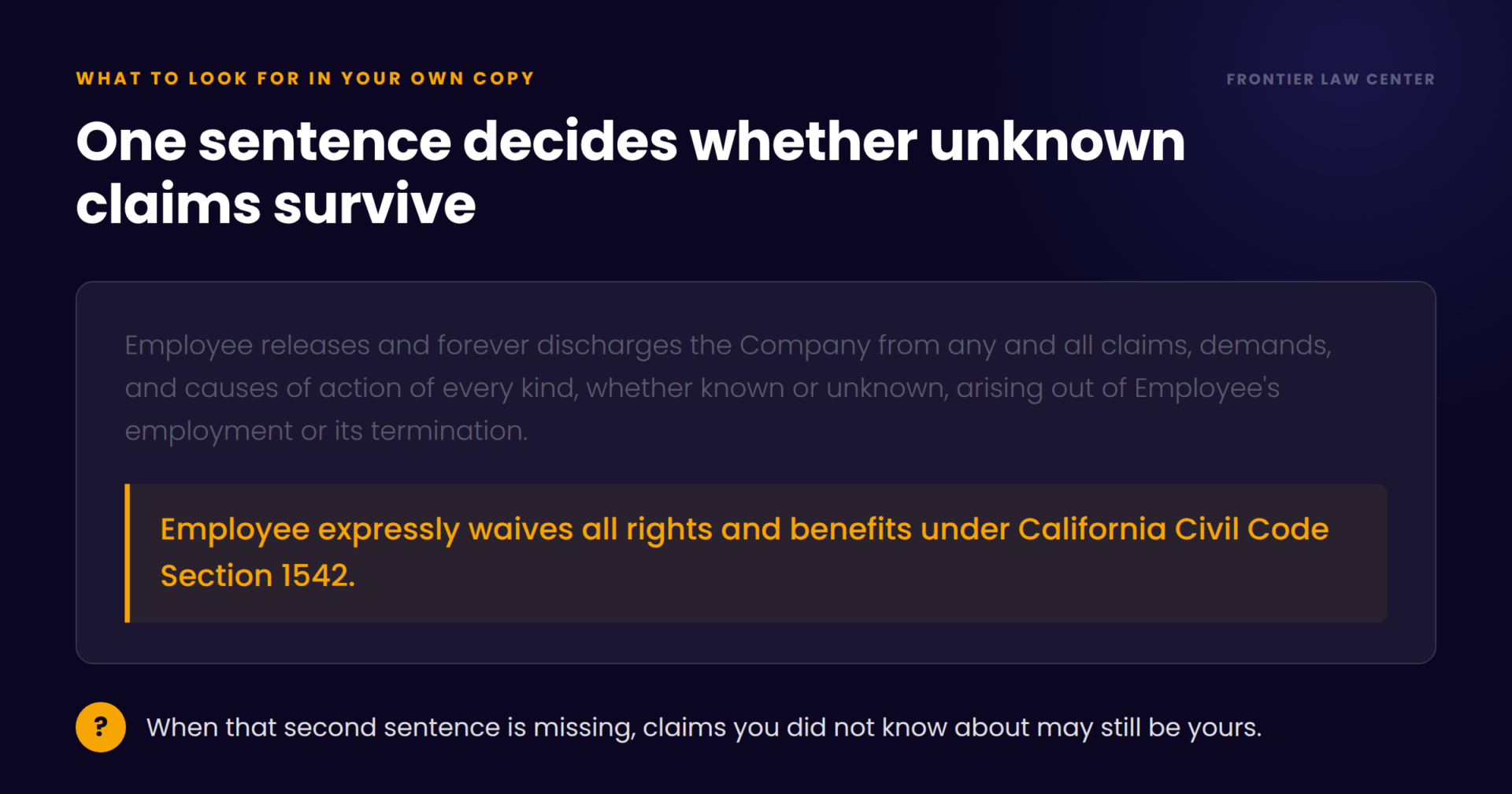
Here sits the rule that most employees usually never notice. Under California Civil Code 1542, a general release does not reach claims you neither knew nor suspected. In fact, that protection holds whenever knowing would have changed your decision. So employers add a separate sentence asking you to waive Section 1542 by name. When that sentence never appears, claims you genuinely did not know about may still belong to you. So go find that number in your own copy right now. Searching the file for 1542 takes about ten seconds.
When You Can Still Sue After Signing a Severance Agreement in California
You can still sue after signing a severance agreement in California when the claim falls outside what a release may legally cover. Earned wages, agency charges, and employer conduct that happened after you signed all survive your signature.
California voids some waivers outright, while federal agencies refuse to honor others however the deal reads. So the table below separates what a typical release covers from what it cannot reach.
| Claim or Right | What a Signed Release Does | Governing Rule |
|---|---|---|
| Wages you already earned before your last day | Cannot waive them | California Labor Code 206.5 |
| Discrimination or harassment you knew about at signing | Usually waives it | Contract law and FEHA |
| Claims you did not know about at signing | Depends on the wording | California Civil Code 1542 |
| Filing a charge with a government agency | Cannot block it | EEOC guidance and FEHA |
| Discussing harassment or discrimination publicly | Cannot silence you | SB 331, the Silenced No More Act |
| Conduct that happened after you signed | Falls outside the release | Contract law |
| Workers' compensation and unemployment benefits | Cannot waive them | Labor Code and Unemployment Insurance Code |
Rights a Signed Severance Release Cannot Touch in California
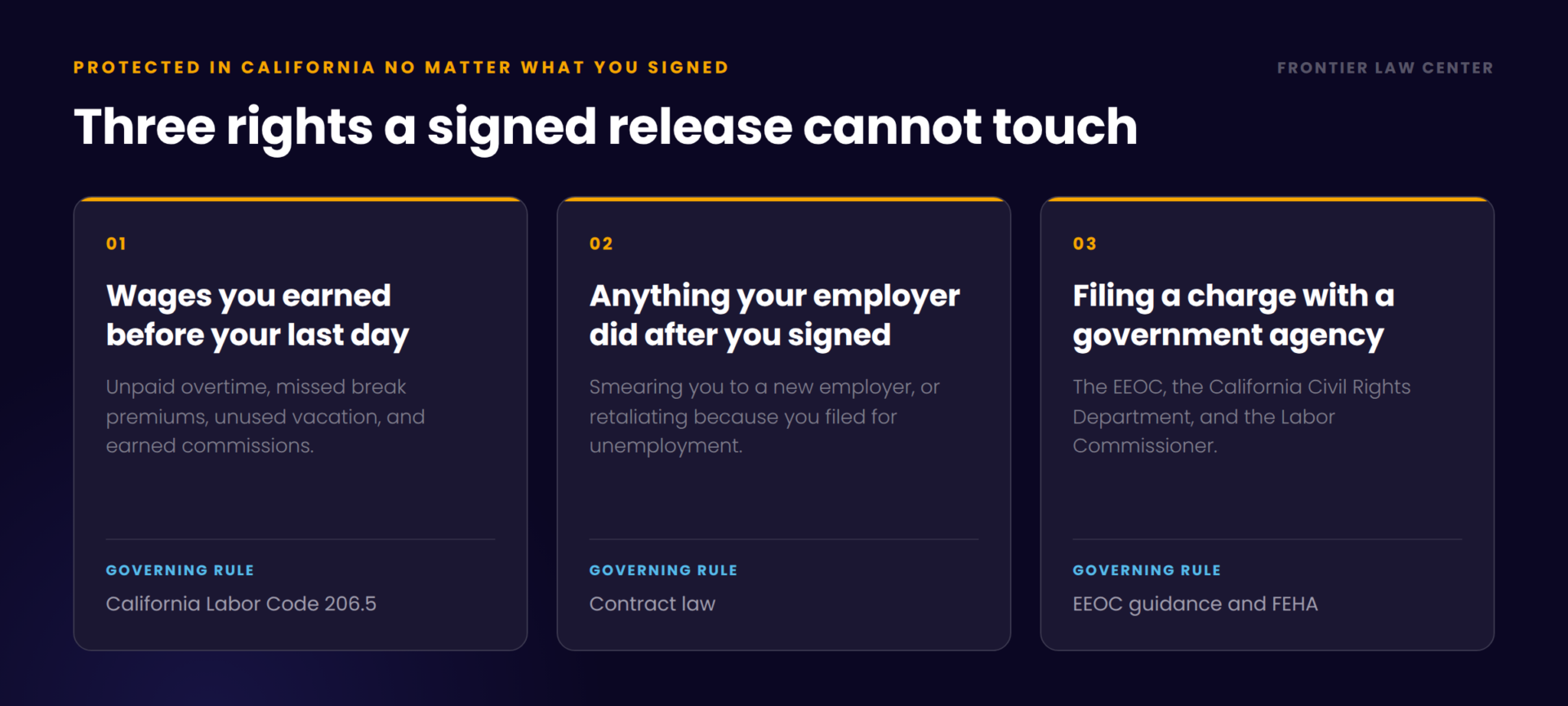
Three protections hold up no matter how broadly your release was drafted. Still, each one leaves room to sue after signing a severance agreement. So check all three before you decide the matter is settled.
Wages You Already Earned Before Your Last Day
First, California treats the wages you already earned as untouchable. Under Labor Code 206.5, an employer cannot require a release of wages already due unless it paid them first. So any release signed in violation of that rule is null and void. So unpaid overtime, missed meal premiums, unused vacation, and earned commissions tend to survive a release. In addition, our guide to unpaid wages in California explains how those claims move forward. Meanwhile, the money at stake often tops the severance check itself.
Anything Your Employer Did After You Signed
Second, a release only covers conduct that already happened. So nothing in that file shields your former boss from claims that arise later. For example, your former employer might smear you to a new employer or retaliate because you filed for unemployment. Those events all land well outside the release. Our breakdown of the California final paycheck law covers what you were owed on the way out.
Your Right to Report Misconduct to a Government Agency
You may always file a charge, even after signing. Finally, the EEOC has stated plainly that no agreement can limit your right to file or assist an investigation. In addition, the same rule reaches the California Civil Rights Department and the Labor Commissioner. Though a release may block your own recovery, it cannot stop an agency from looking into what your employer did. You also keep the money you were paid, since filing a charge later does not force you to hand the severance back.
When a California Court Can Set Aside a Signed Severance Agreement
Sometimes the release itself turns out to be unenforceable, which opens a second path to sue after signing a severance agreement. California courts decline to enforce agreements that employees never truly entered freely. Even so, none of these arguments works alone, and each one demands proof.
Severance Paperwork Signed Under Pressure or False Information
Duress makes a contract voidable when unlawful conduct or threats overcome a person’s free will. Meanwhile, fraud does the same work when an employer misstates a key fact to get a signature. For example, consider an employer who claims the offer expires within the hour when no deadline exists. Still, ordinary pressure will not clear this bar, since courts set it high on purpose.
The Five Business Day Review Period California Requires
California also gives you review time by law. Under SB 331, the Silenced No More Act, your employer must tell you in writing that you may consult an attorney. Then it must allow a reasonable period of at least five business days. You may still sign earlier, though only if that choice stays knowing and voluntary rather than forced. Meanwhile, our severance agreement review page explains what that process involves once a case moves forward.
The Revocation Window Employees Over 40 Often Miss
Employees who are 40 and over get a second chance written into federal law. The Older Workers Benefit Protection Act requires 21 days to consider an age discrimination waiver and grants 7 days after signing to revoke. Those seven days pass fast, so our post on whether to sign a severance agreement covers those federal timelines.
- Your employer told you the offer expired that same day
- No one put in writing that you could consult an attorney first
- The review window ran shorter than five business days
- You are 40 or over and never got the full 21 days to consider it
- Someone told you the release only covered unemployment benefits
- Signing happened in the same meeting where you learned you were let go
- The agreement never mentions Civil Code 1542 anywhere in the text
What a California Severance Agreement Cannot Stop You From Doing
No severance agreement in California can keep you quiet about unlawful conduct at work. Since SB 331 took effect, a separation agreement may not stop you from disclosing unlawful acts, harassment and discrimination included. In fact, the statute requires employers to state that nothing in the document prevents you from disclosing unlawful acts at work.
So a non-disparagement clause cannot muzzle you about illegal conduct, whatever its wording suggests. Employers may still protect trade secrets and your payout figure, though the misconduct stays yours to discuss. In other words, employees who cannot sue after signing a severance agreement still keep the right to speak up. Read that clause with care, because an overbroad one points to a file drafted before these rules landed. Similarly, Workplace Fairness explains how these limits apply to severance agreements more broadly.
What to Do If You Want to Sue After Signing a Severance Agreement
Of course, nothing here requires you to file anything this week. Still, a few early steps protect options that employees often give away while they decide what to do next. Our wrongful termination page covers how these claims move from the first call forward.

Read the Release Paragraph and the Definitions Around It
Open your copy and locate the release language first. Then look for the Section 1542 waiver, the effective date, and any clause describing what you may still report. In most cases, those four items answer the question on their own. Write down what you find, since the outcome turns on wording rather than legal theory.
Write Down the Timeline While the Dates Stay Fresh
Usually memory fades faster than anyone expects during a rough exit. So put the sequence on paper now, noting when you learned each fact and when you signed. Whether you found the problem before or after signing often decides the whole question. Ultimately, that one point drives the unknown claims rule under Civil Code 1542.
Check Which Filing Deadlines Are Still Running
Meanwhile, your deadlines never paused while you weighed the offer. FEHA claims reach the California Civil Rights Department within three years of the last violation. By contrast, federal claims run on much tighter clocks. So our guide to the employment statute of limitations breaks down each clock in turn. Meanwhile, our post on what to do after being fired covers the practical steps that follow a termination.
Questions California Employees Ask After Signing Severance Paperwork
These questions come up in nearly every first call with a California employee weighing whether to sue after signing a severance agreement.
How Do I Take Back a Severance Agreement I Already Signed in California?
Taking it back is possible in narrow circumstances, and the window closes fast. Employees who are 40 and over get 7 days to revoke an age bias waiver under federal law. Still, some deals build in their own window beyond that. Once those days pass, you must show the agreement was never valid at all. Check the revocation clause in your copy before assuming the deadline already expired.
Do I Have to Give the Severance Money Back If I File a Claim Against My Employer?
You keep the money when you file a charge with a government agency. The EEOC has confirmed that employees who file a charge after signing a waiver keep what they were paid. A lawsuit works differently, since some deals ask for the money back first, and courts do not always enforce those clauses. Ultimately, the wording in your own copy settles that question.
Can My Former Employer Sue Me for Breaking a Severance Agreement in California?
An employer can sue for breach, though what counts as a breach is narrower than most deals imply. Still, filing a charge, reporting unlawful conduct, or discussing harassment and bias cannot support a breach claim in California. By contrast, sharing trade secrets or the payout figure is a different matter. Read the clause before you assume either extreme fits your case.
Does Signing Severance Stop Me From Filing With the California Civil Rights Department?
No agreement can take that right away from you. Still, you keep the ability to file with the California Civil Rights Department and join the review that follows. However, a valid release does limit your own ability to collect money through that route. Either way, the agency case itself goes on no matter what you signed.
What Happens If My Employer Never Gave Me Five Business Days to Review the Agreement?
That gap gives you a real argument about whether the deal holds up. In California, employers must tell you that you may consult a lawyer and then allow at least five business days. So skipping either step weakens the claim that your waiver was knowing and voluntary. Save any email or text showing when you received and returned the document.
Can I Still Collect Unpaid Overtime After Signing a Severance Release in California?
Yes, in most cases, because California voids releases covering wages you already earned. Labor Code 206.5 makes any such release null and void unless your employer paid those wages before asking you to sign. For example, unpaid overtime, missed break pay, and earned commissions all fall in that group. Gather your pay stubs and schedules, since those records carry the claim.
Find Out Whether You Can Still Sue After Signing Your Severance Agreement
Months can pass before the pieces fall into place, and that delay does not automatically end your claim. You do not need to understand the law first.
Frontier Law Center represents California employees who signed severance paperwork before anyone explained what it meant. Contact Frontier Law Center for a free case evaluation and find out where you actually stand.
More Blogs

What to Do If You’re Sexually Harassed at Work in California
What to Do If You’re Sexually Harassed at Work in California

How to Tell If Discrimination in Hiring Cost You a Job in California
How to Tell If Discrimination in Hiring Cost You a Job in California

PAGA Reform Explained, What Changed for California Employees
PAGA Reform Explained, What Changed for California Employees

Quid Pro Quo Harassment Examples Every California Employee Should Recognize
Quid Pro Quo Harassment Examples Every California Employee Should Recognize

Race Discrimination in the Workplace and Your Rights as a California Employee
Race Discrimination in the Workplace and Your Rights as a California Employee

AI Layoffs in California and What to Do If an Algorithm Put You on the List
AI Layoffs in California and What to Do If an Algorithm Put You on the List